
Published: 21 October 2026 · İnter Servis Ekipmanları
Why Extraction at Source?
Carbon monoxide, nitrogen oxides and diesel particulates emitted while the engine is running build up quickly in an enclosed space. General ventilation tries to dilute these gases; extraction at source, by contrast, takes the gas directly from the exhaust pipe and discharges it outside before it mixes with the air. This approach is more efficient both for employee health and in terms of heating and cooling energy.
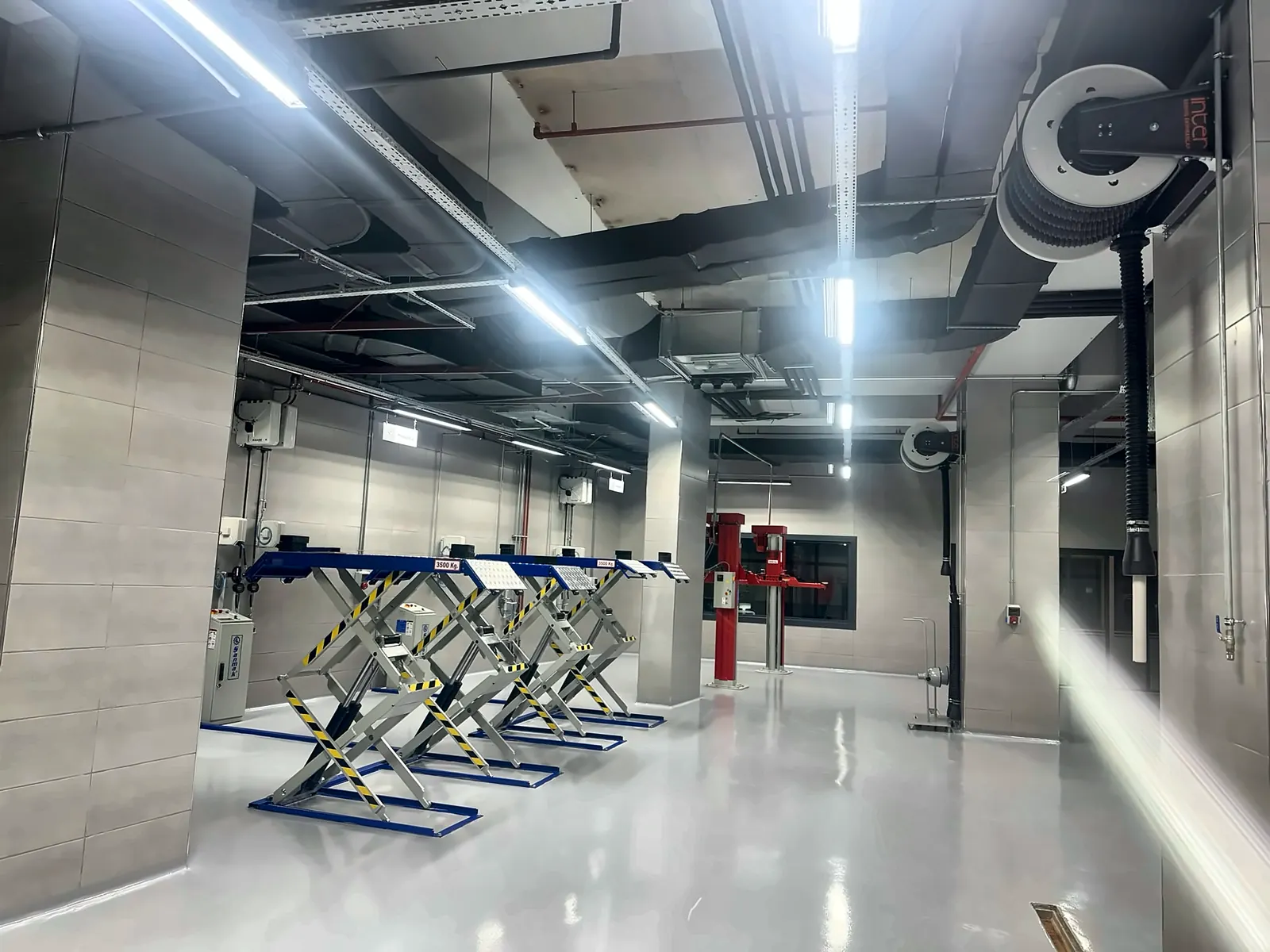
Fixed Hose Reel System
A hose reel is mounted above each vehicle lift or workstation. The technician pulls down the hose and fits the nozzle to the exhaust; when the job is done, the hose reel retracts the hose. It is the most practical solution for car and van service centres where vehicles stay at specific vehicle lifts.
- Each station operates independently
- The floor stays clear and the hose is not crushed
- Spring-driven or motorised hose reel options
Rail System
The hose is carried on trolleys that slide along a rail mounted on the ceiling or wall. As the vehicle moves forward, the hose moves with it. It is preferred in service lanes where vehicles are driven from one station to the next, on test lines and in heavy commercial vehicle workshops.
- Uninterrupted extraction while the vehicle is moving
- Several stations served by one extraction line
- A safety fitting that releases the nozzle safely at the end of the line
Questions to Ask When Deciding
- Do vehicles change position during work?
- Are there heavy commercial vehicles with vertical exhausts in the workshop?
- How many vehicles run their engines at the same time?
- Is the ceiling structure suitable for rail suspension?
- Will the number of stations increase in future?
Both Together
In many workshops the best result is achieved by using both systems together: hose reels at fixed maintenance stations, and a rail system in the vehicle entry/exit lane or test area. Both can be connected to the same fan and duct infrastructure.
For details, see our fixed hose reel and rail-mounted exhaust extraction pages, or request a site survey for your workshop.