
Frequently Asked Questions
The most frequently asked questions about the quote process, site surveys and our systems.
General
Which regions do you serve?
We operate from our base in Esenyurt, Istanbul. You are also welcome to contact us about projects outside Istanbul; we plan according to the scope of the project.
What do I need to request a quote?
Simply fill in the quote form or call us. For a firm quote we usually carry out a site survey; sharing your workshop plan and vehicle lift layout, if available, speeds up the process.
Is the site survey charged?
We clarify the site survey terms during our initial discussion, depending on the location and scope of the project.
Do you install all the services of a new workshop in one go?
Yes. We plan and install vehicle exhaust extraction, oil dispensing and collection, and compressed air and water hose reel lines as a single project. This way the line routes do not clash, and installation proceeds with one team and one schedule.
Do you provide after-sales support?
Yes. We provide maintenance, repair, spare parts and calibration services for the systems we install.
Vehicle Exhaust Extraction Systems
Vehicle Exhaust Extraction Systems
Does a vehicle exhaust extraction system replace general ventilation?
No, the two complement each other. General ventilation refreshes the workshop air; a vehicle exhaust extraction system captures the gas at source before it mixes with the air. With a vehicle exhaust extraction system in place, general ventilation can operate at a lower capacity.
Should I choose a fixed hose reel or a rail-mounted system?
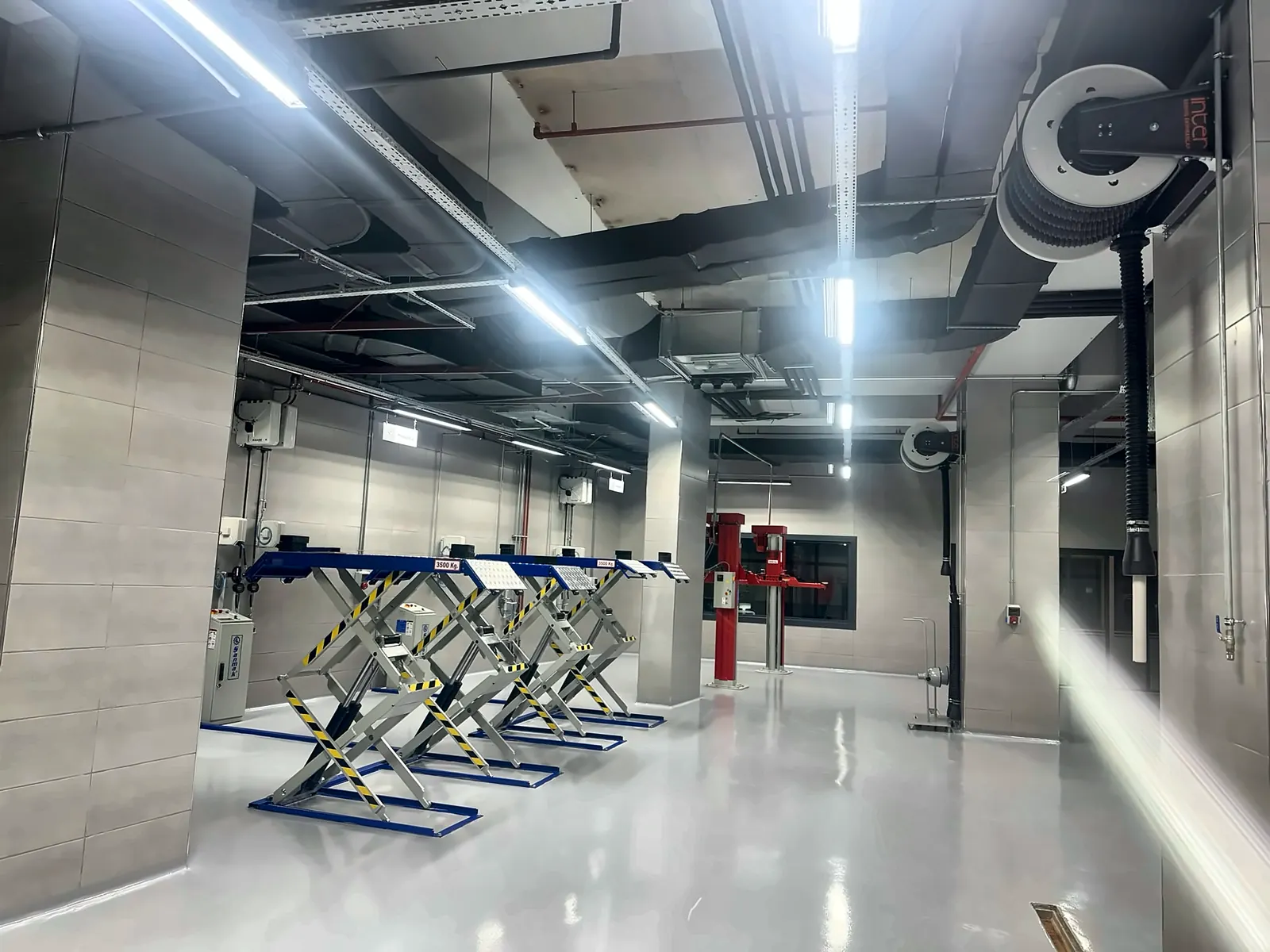
If vehicles stand still on specific lifts, a fixed hose reel system is the most practical solution. If extraction is needed while the vehicle is moving (test lane, service lane, heavy commercial vehicles driving in and out), or if there are many workstations along a long line, a rail-mounted system is more suitable. In some projects we use both in the same workshop.
How many points can one fan serve?
Fan capacity is calculated from the number of vehicles running at the same time, the hose diameter and the duct length. For this reason we do not give a fixed number; we determine it during the site survey based on how your workshop is used.
Can it be retrofitted in an operating workshop?
Yes. We plan the duct routing around the existing structure and schedule the installation section by section to minimise disruption to the workshop’s operations.
Is it suitable for heavy commercial vehicle and bus workshops?
Yes. For large-diameter tailpipes and vehicles with vertical exhaust stacks, we select a suitable hose diameter and nozzle and, where necessary, a rail-mounted system.
How much heat can the exhaust hose withstand?
The hose is selected from a material suitable for the exhaust outlet temperature. Standard hoses are sufficient for petrol and diesel passenger cars; for heavy commercial vehicles and test lines running at idle for long periods, we recommend hoses with higher temperature resistance.
Is the system noisy?
The extraction fan is usually installed outside the building or at ceiling level, away from the working area. With a correctly selected fan and duct design, no disturbing noise is generated inside the workshop.
Fixed Hose Reel Exhaust Extraction System
What hose length does a hose reel need?
It is calculated from the mounting height of the hose reel, the lifting height of the vehicle lift and the position of the tailpipe. The hose must reach comfortably both when the vehicle is on the ground and when it is on the lift.
Spring-return or motorised hose reel?
In car service centres with standard ceiling heights, a spring-return hose reel meets most needs. If the ceiling is high, the hose diameter is large or the reel is used very frequently, a motorised hose reel is preferred.
Do you maintain our existing hose reels?
Yes. We carry out maintenance and repair of hose reels, including replacement of springs, latch mechanisms, hoses and nozzles.
Can two vehicles be connected to one hose reel?
A Y-nozzle can be used for twin exhausts. For two separate vehicles, however, we recommend installing a separate hose reel at each station; otherwise hoses end up trailing across the working area.
Rail-Mounted Exhaust Extraction System
How long can a rail-mounted system be?
The rail length is planned according to the length of the workshop line. On long lines, fan capacity and duct connection points are selected accordingly.
Can rail-mounted and hose reel systems be used in the same workshop?
Yes. In some projects we use hose reels at fixed workstations and rail-mounted systems in sections where vehicles move; both can be connected to the same fan and duct infrastructure.
Is the rail profile mounted to the ceiling or to the wall?
Both are possible, depending on the building structure. In steel-frame workshops it is usually suspended from the roof trusses; in reinforced concrete buildings, from column or wall brackets.
Oil Distribution and Collection Systems
Central Oil Distribution System
How many different oils can lines be installed for?
There is no limit; a separate line can be installed for every oil type you use in the workshop. In practice, the two to four most frequently used oil types are put on the central line, and less frequently used ones are handled with mobile units.
Do the pumps run on electricity?
Workshops generally use pneumatic pumps driven by compressed air. For this reason, the installation is planned together with the compressed air line.
How often should the meters be checked?
Meter accuracy can drift over time. We recommend checking them at regular intervals depending on usage; for this we offer an oil meter calibration service.
Can central distribution also be installed for grease?
Yes; a central grease line can be installed with grease pumps and grease hose reels. Because of its flow characteristics, a grease line is planned with different pumps and pipe diameters from an oil line.
Do the guns drip?
Good-quality, well-maintained guns do not drip. We use a gun holder and drip tray at each station to keep the floor clean.
Fresh Oil Dispensing System
Plastic tank or steel tank?
The choice depends on the dimensions of the oil room, fire and safety requirements, required capacity and budget. We assess your existing space during the site survey and make a recommendation.
Can our existing tanks be used?
Yes, if they are in suitable condition. We can add new filling, pump and level connections to existing tanks.
What if the oil room is far from the workshop?
As the line length increases, pump capacity and pipe diameter are selected accordingly. On long lines we calculate the pressure loss to ensure sufficient flow at every station.
Mobile Lubrication Equipment
Which brands do you work with?
For the current product range of the brands we distribute, see the catalogues page or call us directly.
Can I convert a mobile unit to a central line later?
Some components of the mobile unit, such as the gun and meter, can also be used on a central line. We assess your existing equipment when planning the transition.
Are spare parts available for mobile units?
We supply common spare parts for the brands we distribute and carry out maintenance and repairs in our workshop or on site.
Waste Oil Collection and Discharge System
Can our existing oil drainers be connected to the system?
Most oil drainers can be connected to the discharge point with a suitable adapter. We check the models of your units during the site survey.
Where should the waste oil tank be placed?
In a separate, enclosed area with leak protection, where the licensed waste oil collector can transfer the oil to a tanker. It can be planned together with the oil room.
Can antifreeze and brake fluid go into the same tank?
No. Waste engine oil and other wastes such as antifreeze and brake fluid must be collected separately. Where necessary, we plan separate tanks and lines for different wastes.
Automation Systems
Computer-Controlled Oil Management System
Can it be added to our existing central oil distribution line?
The condition of the existing line is assessed during the site survey. On suitable lines, control units, meters and software can be added while keeping the pump and pipework.
Does the system need calibration?
Yes. For the measured and dispensed oil to match, the meters must be checked and calibrated periodically. We carry out the calibration and the reporting.
Do you service MDS 2000 systems?
Yes. We provide installation, calibration and after-sales support for Badger Meter MDS 2000 systems.
Does the system require an internet connection?
It depends on the system configuration. Systems running on a local network can record dispensing without an internet connection; remote reporting requires a network connection.
Real-Time Oil Tank Level Monitoring System
Can it be added to our existing tanks?
In most cases, yes. The tank type, port connections and layout are assessed during the site survey, and the appropriate sensor and mounting method are selected accordingly.
How accurate is the measurement?
Accuracy depends on the sensor type, tank geometry and calibration. During installation, the tank dimensions are entered into the system and the reading is verified against the actual fill quantity.
Can it also be used on a waste oil tank?
Yes. Level monitoring and overfill warning for the waste oil tank are configured separately; for details, see the waste oil tank overfill prevention system page.
Waste Oil Tank Overfill Prevention System
Can it be installed on our existing waste oil tank?
Usually, yes. The tank type, a connection point suitable for mounting the sensor and the way the discharge pump is controlled are assessed during the site survey.
Can we also hear the warning in the workshop?
Yes. The warning can be given not only in the oil room but also at a point visible in the workshop.
What happens in a power failure?
This is addressed in the design; the preferred approach is to configure the discharge line so that it remains in a safe state. The details depend on the pump and control set-up used.
Compressed Air and Water Hose Reel Installation
Compressed Air Hose Reel Installation
Do you also supply compressors?
We design the installation around your existing or new compressor. If a compressor needs to be selected, we calculate the required flow rate and pressure and advise you.
Can our existing air line be improved without replacing it?
Often, yes. Adding air service units, correcting drop connections, adding drain points and eliminating leaks can noticeably improve the line’s performance. We first inspect the current situation on site.
Can air and water hose reels be installed at the same point?
Yes. At workstations we install air, water and oil hose reels grouped on the same panel or wall.
What pipe material do you use?
Depending on the needs of the project, galvanised steel, stainless steel or aluminium compressed air piping systems can be used. The choice is made according to line length, budget, expansion requirements and ambient conditions.
Water Hose Reel Installation
Can it be used for hot water?
Yes; if hot water is to be used, the hose reel and hose are selected to suit that temperature.
Can a pressure washer be connected?
If a pressure washer is to be used, the hose reel, hose and connections must be rated for its working pressure. We clarify your intended use during the site survey.
Is there a risk of freezing in winter?
For lines passing through unheated areas, the route and insulation are planned to prevent freezing. The hose reels are usually mounted inside the heated workshop.
Maintenance and Measurement Services
Digital Oil Meter Calibration
Does the workshop have to stop for calibration?
No. We calibrate station by station; only the gun being checked is out of use at any one time.
Do you provide a report?
Yes. We issue a report showing the values before and after calibration for each gun.
Do you calibrate meters from different brands?
We can calibrate most digital and mechanical oil meters that allow adjustment. Letting us know the brand and model in advance makes preparation easier.